ST CANICE’S LEGACY OF GRATITUDE
Just this week the mental health support group ‘Beyond Blue’ published research that found a third of 5,000 people surveyed were experiencing distress due to isolation and loneliness.
Of those, three-quarters reported anxiety issues, two-thirds depression and a whopping 29% had had suicidal thoughts. Overall the researchers estimate that each year 2 in 10 Australians experience a mental illness and 45% do at some point in their life. It’s people of all ages, sexes, ethnicities, professions.
Undoubtedly, we are better today than we were in the past at identifying mental illnesses as well as physical ones, and probably more candid and sympathetic about them, but it’s clear a lot of people are hurting, often silently, unbeknownst to family, friends and colleagues, without professional help or social support. They feel like lepers. Something about modernity seems to be contributing to this: Beyond Blue CEO Georgie Harman thinks the breakdown of community connection is a factor; others include financial, work or study pressures; relationship breakdown; harassment, including cyber-bullying; substance abuse; and more. But I wonder if there is also a spiritual element to today’s mental health challenges.
Many people today are inoculated against religion by the media, education, culture.
But a large body of research suggests that, on the whole, religious beliefs and practices are associated with greater wellbeing, less anxiety, depression and suicidal ideation, greater social support, and less substance abuse.
Though the evidence is controverted, credible studies suggest prayer, meditation, ritual and moral teaching can help prevent or heal mental illness, even if there’s no guarantee. Faith and faith communities underwrite wellbeing by offering meaning and direction, providing a range of educational, health, welfare and pastoral supports, and mediating divine assistance. They also cultivate character traits that contribute to psychological resilience.
And they offer keys to understanding the sacred and the self, which can help maintain balance, perspective and hope. Secular modernity has found no working substitute.
Today’s readings invite us to reflect upon what it means to be healed and the role that faith plays in our own restoration. After all, we know that humans are complex beings with physical, emotional, intellectual, social and spiritual dimensions, and so healing them is often about more than biology and chemistry. The affliction common to our first reading (2 Kgs 5:14-17) and Gospel (Lk 17:11-19) is leprosy or Hansen’s Disease, a chronic bacteria infection that affects the skin, peripheral nerves, upper respiratory tract and eyes.
In societies like ancient Israel it also meant being ostracised from cult and community. In both of today’s stories, restoration will mean more than a physical fix.
When the Syrian general Naaman is told by the prophet Elisha to wash seven times in Jordan, he reluctantly complies, and his skin is restored to that of a little child. He gratefully acknowledges the God of Israel, having glimpsed a Power infinitely greater than military or technological might. Yet not everyone is so grateful. In our Gospel ten lepers are cleansed by Jesus but only one returns to give thanks. Jesus is miffed: “Where are the other nine?” He asks. Only the Samaritan, a despised outsider, kneels in thanksgiving. Jesus then declares, “Your faith has saved you.” The other nine have received physical healing, a temporary postponement of sickness and death. But our grateful Samaritan was open to receiving so much more: he has received salvation, eternal life.
Throughout Scripture, obtuseness and ingratitude are no rare thing. Think of Israel so quickly murmuring against God after being delivered from bondage. Or of the crowd, after witnessing Jesus’ miraculous multiplication and feeding, coming back to demand more signs. Human beings have a remarkable capacity to receive blessings whilst remaining blind to their Source, enjoying the gifts whilst ignoring the Giver!
Paul, writer of our epistle (2 Tim 2:8-13), had more than his share of Canice’s ship-wrecks, gaoling and beatings. Martyrdom was fast approaching. Yet he declares his steadfast confidence, that having died with Christ those with faith “shall also live with Him”. Paul’s faith was no mere placebo but rather an encounter with the Risen Lord that reordered his entire existence and sustained him through thick and thin. His response was a sincere and constant thanksgiving, true eucharisteo.
Cay-neck of Ar-boo Cainnech of Aghaboe, known today as St Canice, Kenneth or Kenny, was a sixth century Gaelic monk and missionary to Scotland and Ireland. Along with his friend St Columba (Colmcille), he learnt to make prayer, not a last resort when all science had failed, but a first instinct of those who rely upon God. The medieval Life of Columba by Adom/nán records a dramatic moment when Columba was at sea. A violent storm arose and Columba’s companions feared for their lives. Yet he remained calm, confident that his mate Canice was praying for him. Meanwhile Canice, in his monastery in Ar-boo Aghaboe, had had a vision of Columba’s peril and was imploring God on his knees. The storm subsided and all were saved.
Canice, like Namaan, like Paul, like the Samaritan leper, recognised that since God is the source of our being, we should live in permanent gratitude to Him. And since God is the source of our deepest healing, we should invoke His assistance in our own or each other’s hour of need. Having received God’s mercy ourselves, we can be channels of that mercy to others.
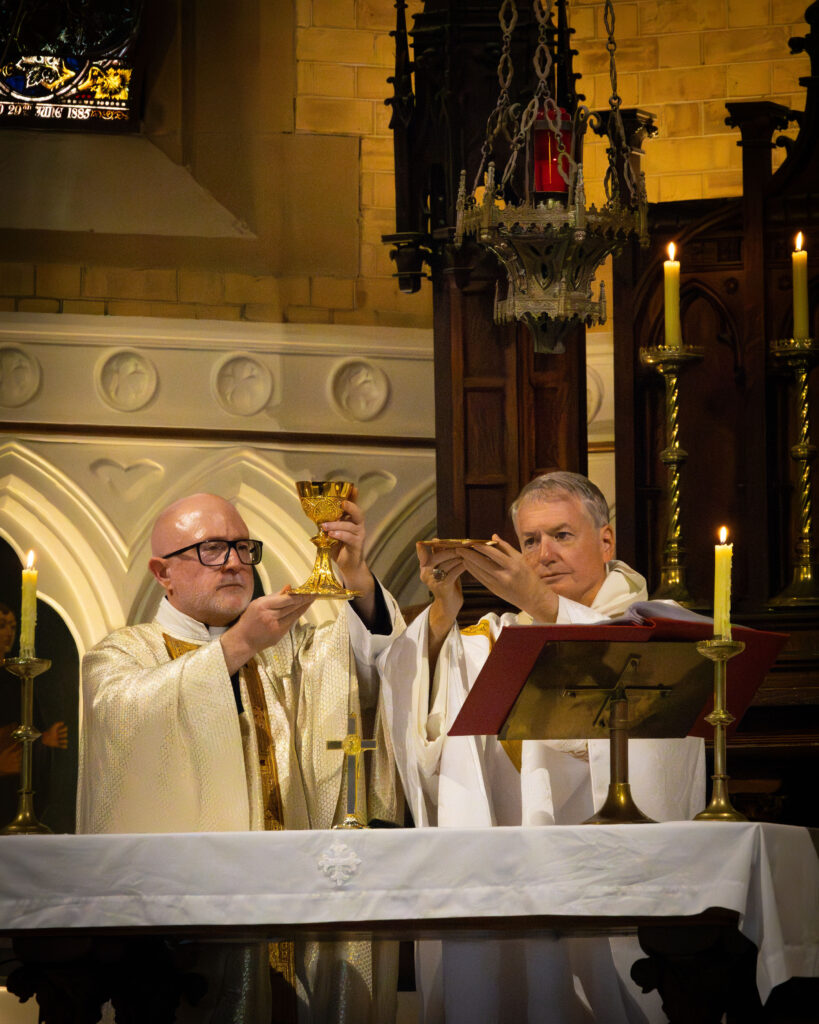
St Canice’s legacy lives on vibrantly in this parish: in Canices Kitchen, feeding the hungry; in David’s Place, offering refuge to the homeless; in Curious Grace, welcoming those at the margins. It embodies the truth that living faith and genuine thanksgiving bear fruit in love. Like our grateful leper we show ourselves to the priest, to the Church, at Mass and more. We invoke Christ’s continual healing not just of our bodies but our hearts and souls as well. And then we serve others, making grateful return to Christ for all He has done for us. So may we hear at the end of Mass, at the end of our good works, at the end of our lives, Christ saying:
“Stand up now and go your way. Your faith has saved you!”